
From 22 to 24 January 2025, the ASEAN Food Security Information System (AFSIS) Secretariat, in collaboration with Japan’s Ministry of Agriculture, Forestry and Fisheries (MAFF), Japan Aerospace Exploration Agency (JAXA), Remote Sensing Technology Center of Japan (RESTEC), and Geo-Informatics and Space Technology Development Agency (GISTDA), successfully conducted the Inception Workshops, the first Seminars for Executive Officials, and the first Hands-on Training Courses for Agricultural Statisticians and Technical Staff in Bangkok and Chonburi Province.
The event, which kicked off on January 22, 2025, at GISTDA Headquarters in Bangkok, featured a seminar titled “Improvement of Rice Paddy Area Statistics and Damage Assessment using Earth Observation Satellites for ASEAN.” Dr. Pakorn Apaphan, Director of GISTDA, Dr. Shinichi Sobue from JAXA, and Dr. Sumanya Ngandee, AFSIS Manager, delivered opening remarks. The seminar focused on exploring innovative methods to enhance the efficiency of rice cultivation statistics, specifically through the use of space technology for monitoring rice cultivation areas
Key discussions included an introduction to ALOS-2 satellite technology, the INAHOR (International Asian Harvest mOnitoring System for Rice), and the use of Earth observation satellites to improve agricultural management and decision-making. The system, developed under the JAXA project, offers powerful tools for estimating rice production and evaluating flood damage, which are vital for timely food security responses.
From January 23 to 24, the event moved to Sriracha in Chonburi Province, where hands-on training courses were held for agricultural statisticians and technical staff at the GISTDA Training Center. These sessions provided participants with practical skills in using the INAHOR system. Training included installing and setting up key software tools, such as Quantum Geographic Information System (QGIS), Google Earth Pro, and Google Earth Engine. Attendees also learned how to configure the INAHOR system and use its features to estimate rice cultivation areas.
This workshop is the first meeting under the Project for Strengthening the ASEAN Food Security Information System (AFSIS) Function for Emergency (SAFER) and the Japan-ASEAN Integration Fund (JAIF) project. The cooperation of ASEAN member countries made this meeting a success. The results of this workshop and the comments received from member countries were used to improve the operation of the INAHOR information technology system.


.JPG)
From 15–16 September 2026, the AFSIS Secretariat, in collaboration with the Japan Aerospace Exploration Agency (JAXA), Remote Sensing Technology Center of Japan (RESTEC), Ministry of Agriculture, Forestry and Fisheries (MAFF) Japan, and the Philippine Statistics Authority (PSA), conducted the “Workshop on Promote rice planted area and production estimation using space-based technologies in the Philippines” at Park Inn by Radisson North EDSA, Quezon City, Manila, the Philippines.

On 19 August 2026, the AFSIS Secretariat participated in the Special Senior Officials Meeting of the 25th Meeting of the ASEAN Ministers on Agriculture and Forestry Plus Three (Special SOM-25th AMAF Plus Three), hosted by the Philippines via video conference. The Meeting was attended by Senior Officials from ASEAN Member States, the Plus Three countries, and the ASEAN Secretariat. The AFSIS Secretariat was represented by Dr. Sumanya Ngandee, AFSIS Manager.
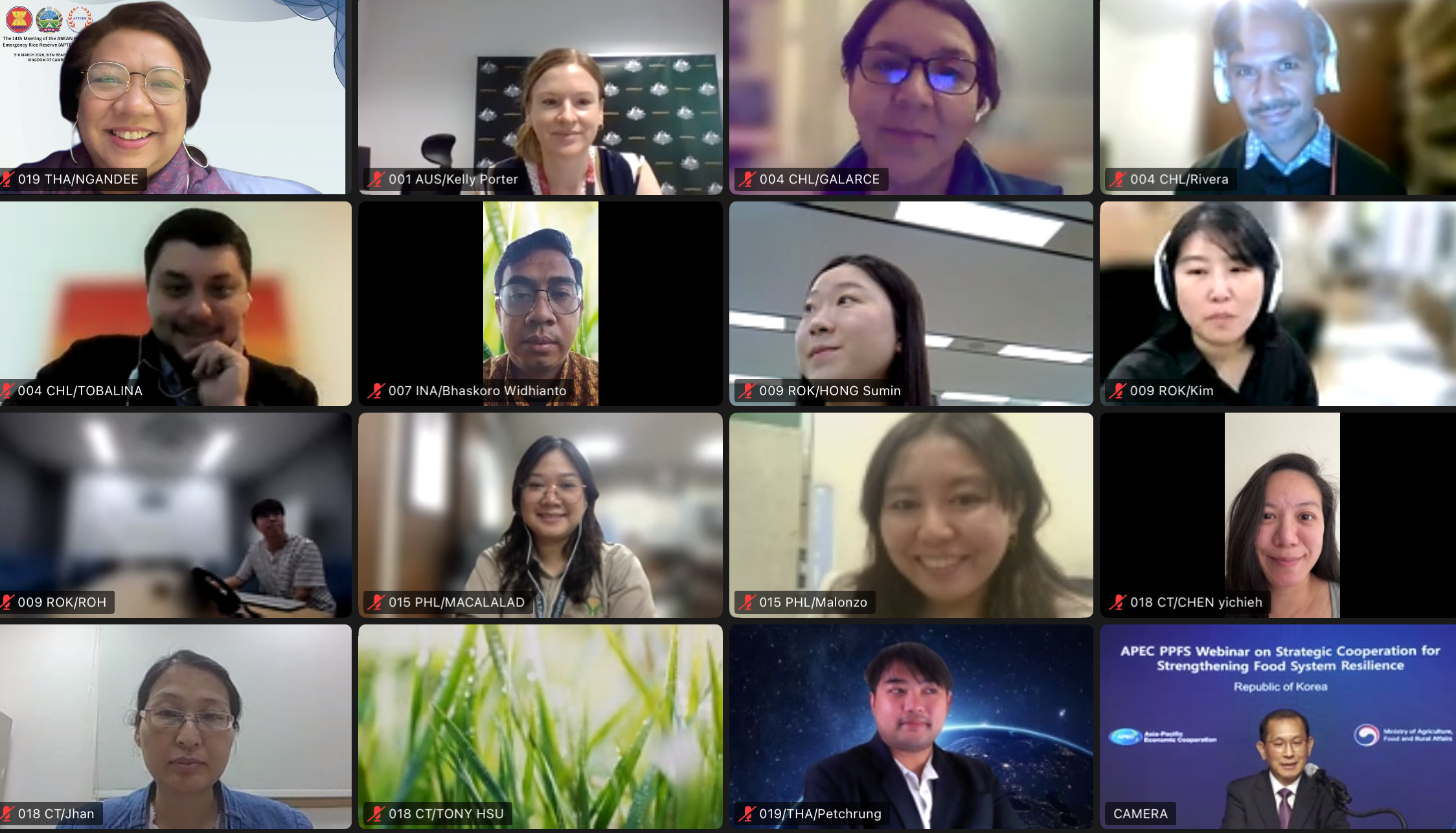
On 29 July 2026, the APEC Policy Partnership on Food Security (PPFS) successfully convened the APEC PPFS Webinar on Strategic Cooperation for Strengthening Food System Resilience via a virtual platform. The webinar was organized by the Ministry of Agriculture, Food and Rural Affairs (MAFRA) of the Republic of Korea as a self-funded PPFS project to promote strategic cooperation and knowledge exchange on strengthening food system resilience across APEC member economies.

The AFSIS Secretariat participated in the 10th International Conference on Agricultural Statistics (ICAS X), held from 8 to 10 July 2026 at the ICE Krakow Congress Centre in Krakow, Poland. Jointly organized by Statistics Poland, Eurostat, the United States Department of Agriculture (USDA), the World Bank Group, and the Food and Agriculture Organization of the United Nations (FAO).

