.jpg)
On 23 April 2026, the AFSIS Secretariat participated in the Ad-Hoc Senior Officials Meeting of the ASEAN Ministers on Agriculture and Forestry (SOM-AMAF), held via a virtual platform, to discuss the implications of recent developments in the Middle East on regional food security and to identify coordinated measures to enhance ASEAN’s food resilience, in preparation for the ASEAN Ministers on Agriculture and Forestry (AMAF) Meeting.
During Agenda Item 4, “Formulation of Coordinated Measures to Enhance Food Resilience in the ASEAN Region,” Dr. Sumanya Ngandee, AFSIS Mangar delivered a briefing on the regional food security situation and proposed coordinated measures to strengthen ASEAN’s resilience in response to emerging challenges.
The presentation highlighted the impacts of situation in the Middle East on ASEAN agricultural sector , particularly rising production costs driven by higher energy prices, increasing fertilizer and agricultural input costs, and disruptions in logistics and trade. These impacts have contributed to mounting pressure on farmers’ profitability and heightened risks to food security across the region.
In this context, AFSIS emphasized the importance of strengthening regional information systems to support timely and evidence-based decision-making. Key proposed measures included enhancing early warning systems, improving access to near real-time food security data, and reinforcing regional trade intelligence to better anticipate and respond to potential supply shocks.
The discussion also underscored the critical role of regional cooperation mechanisms, including APTERR, in ensuring coordinated responses to food security emergencies and supply disruptions.
ASEAN Member States expressed strong support for further enhancing the role of AFSIS, particularly in strengthening analytical capacity, improving data sharing, and developing forward-looking assessments, including scenario-based analyses for key commodities and agricultural inputs.
The Meeting reaffirmed the importance of AFSIS as a key regional mechanism supporting ASEAN’s food security agenda and highlighted the need to further strengthen its functions to address increasingly complex and dynamic challenges.
The AFSIS Secretariat will continue to work closely with ASEAN Member States and partners to enhance regional capacity and ensure the availability of timely, accurate, and actionable food security information..
.jpg)
.png)
.jpg)
.jpg)
.jpg)
.jpg)
.jpg)
.jpg)

On 19 August 2026, the AFSIS Secretariat participated in the Special Senior Officials Meeting of the 25th Meeting of the ASEAN Ministers on Agriculture and Forestry Plus Three (Special SOM-25th AMAF Plus Three), hosted by the Philippines via video conference. The Meeting was attended by Senior Officials from ASEAN Member States, the Plus Three countries, and the ASEAN Secretariat. The AFSIS Secretariat was represented by Dr. Sumanya Ngandee, AFSIS Manager.
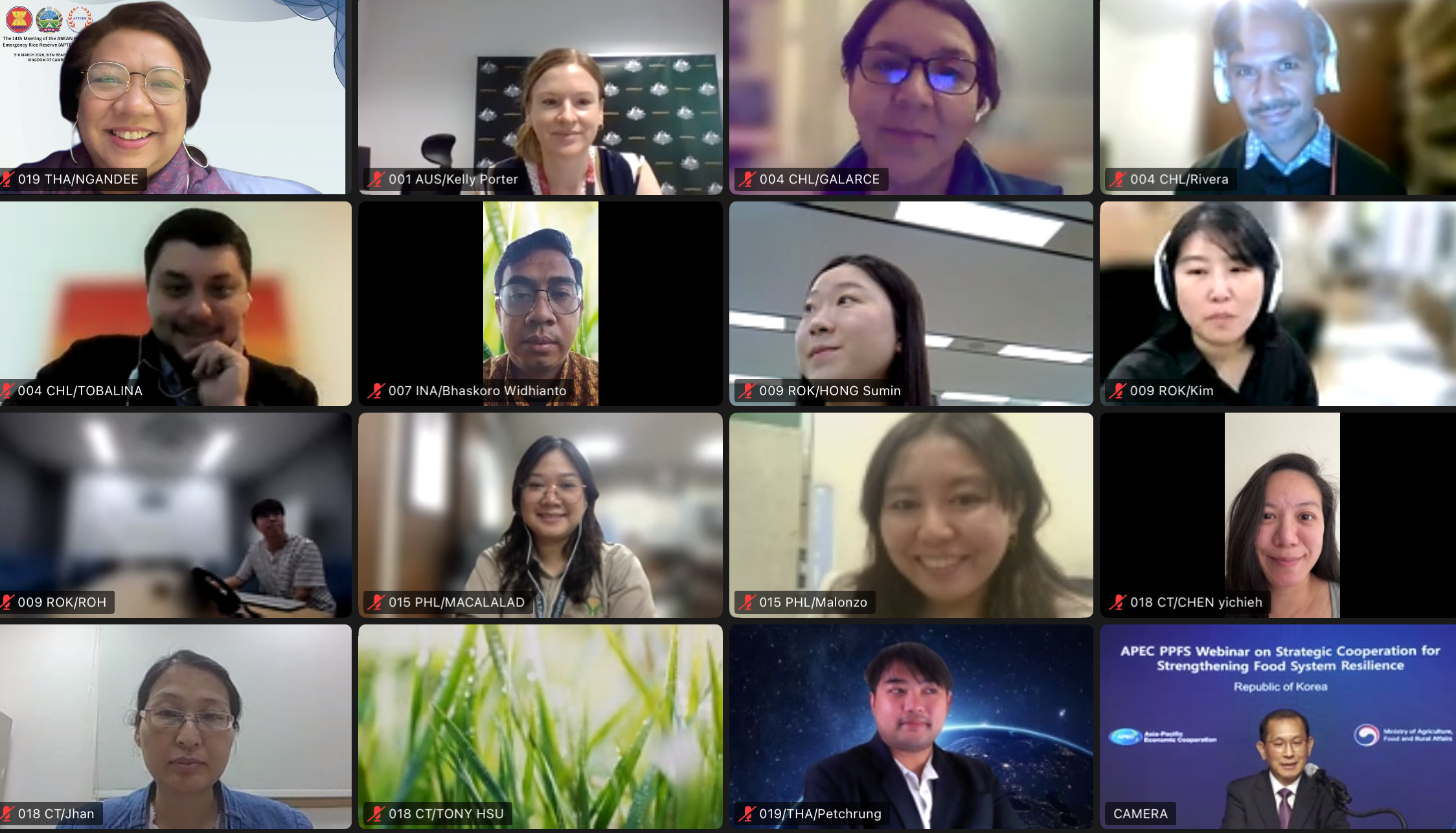
On 29 July 2026, the APEC Policy Partnership on Food Security (PPFS) successfully convened the APEC PPFS Webinar on Strategic Cooperation for Strengthening Food System Resilience via a virtual platform. The webinar was organized by the Ministry of Agriculture, Food and Rural Affairs (MAFRA) of the Republic of Korea as a self-funded PPFS project to promote strategic cooperation and knowledge exchange on strengthening food system resilience across APEC member economies.

The AFSIS Secretariat participated in the 10th International Conference on Agricultural Statistics (ICAS X), held from 8 to 10 July 2026 at the ICE Krakow Congress Centre in Krakow, Poland. Jointly organized by Statistics Poland, Eurostat, the United States Department of Agriculture (USDA), the World Bank Group, and the Food and Agriculture Organization of the United Nations (FAO).
.JPG)
On 24–25 June 2026, AFSIS Secretariat participated in the 46th Meeting of the ASEAN Food Security Reserve Board (AFSRB) via a virtual conference. The Meeting was jointly organized by the AFSRB Secretariat and the Department of Agriculture (DOA), Ministry of Agriculture, Livestock and Irrigation (MOALI) of the Republic of the Union of Myanmar, and was hosted in Nay Pyi Taw, Myanmar.

