ASEAN Food Security Information on the Self-Sufficiency Ratio (SSR)
Food security remains one of the most pressing challenges facing the global community. Across ASEAN, this issue is increasingly influenced by climate change, natural and human-induced disasters, and evolving epidemiological and geopolitical conditions. Recent conflicts and instability in the Middle East have further exposed the fragility of global food supply chains, particularly through disruptions to key trade routes, rising energy and transportation costs, and volatility in global commodity markets. These interconnected pressures continue to affect food availability and affordability, highlighting the importance of monitoring and strengthening self-sufficiency ratios (SSR) to ensure a sustainable and resilient food supply.
Rice (2026)
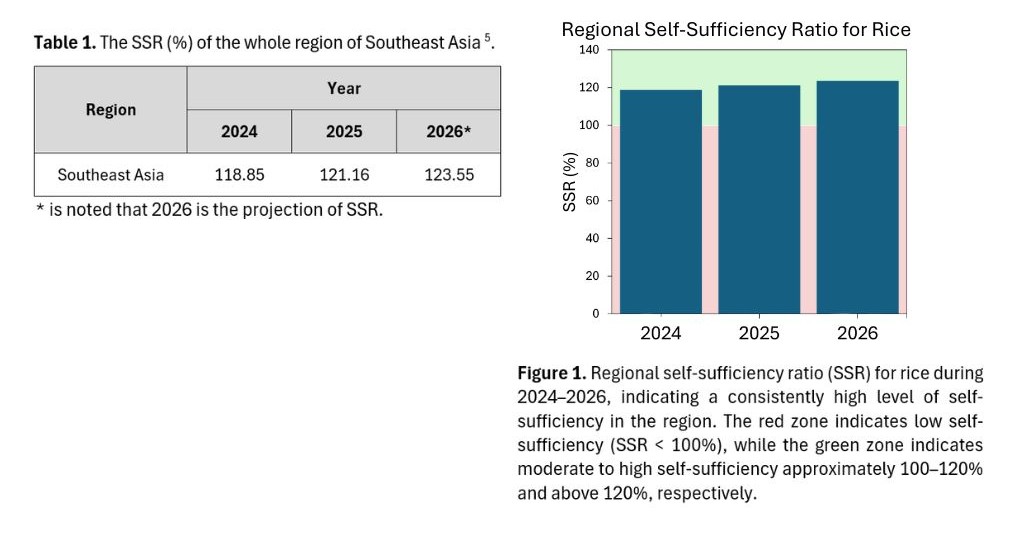
Rice is one of the most important staple food grains for the global population, providing essential energy as well as key nutrients such as minerals and vitamins 1. Southeast Asia is one of the world’s most important rice-producing regions, contributing approximately 40% of global rice exports 2. However, countries in the region may face increasingly unpredictable situations, including natural disasters and challenges related to production factors. The Self Sufficiency Ratio (SSR) as an indicator that measures the extent to which a country can meet its food needs from domestic production. It represents the proportion of locally produced food relative to the total food supply available for consumption (including imports and exports), and is typically calculated as production divided by total domestic supply, multiplied by 100 3. The SSR is widely used to assess food security, support policy planning, and enable global comparisons, as it reflects food availability and nutritional adequacy. A high SSR indicates that a country produces more than it consumes, while a low SSR indicates reliance on imports 4. At the regional level, SSR in Southeast Asia shows that most countries produce more rice than they consume during the period from 2025 to 2026. The regional SSR increased slightly from 121.16% in 2025 to 123.55% in 2026, representing a 2.39 percentage point increase (Table 1 and Figure 1).
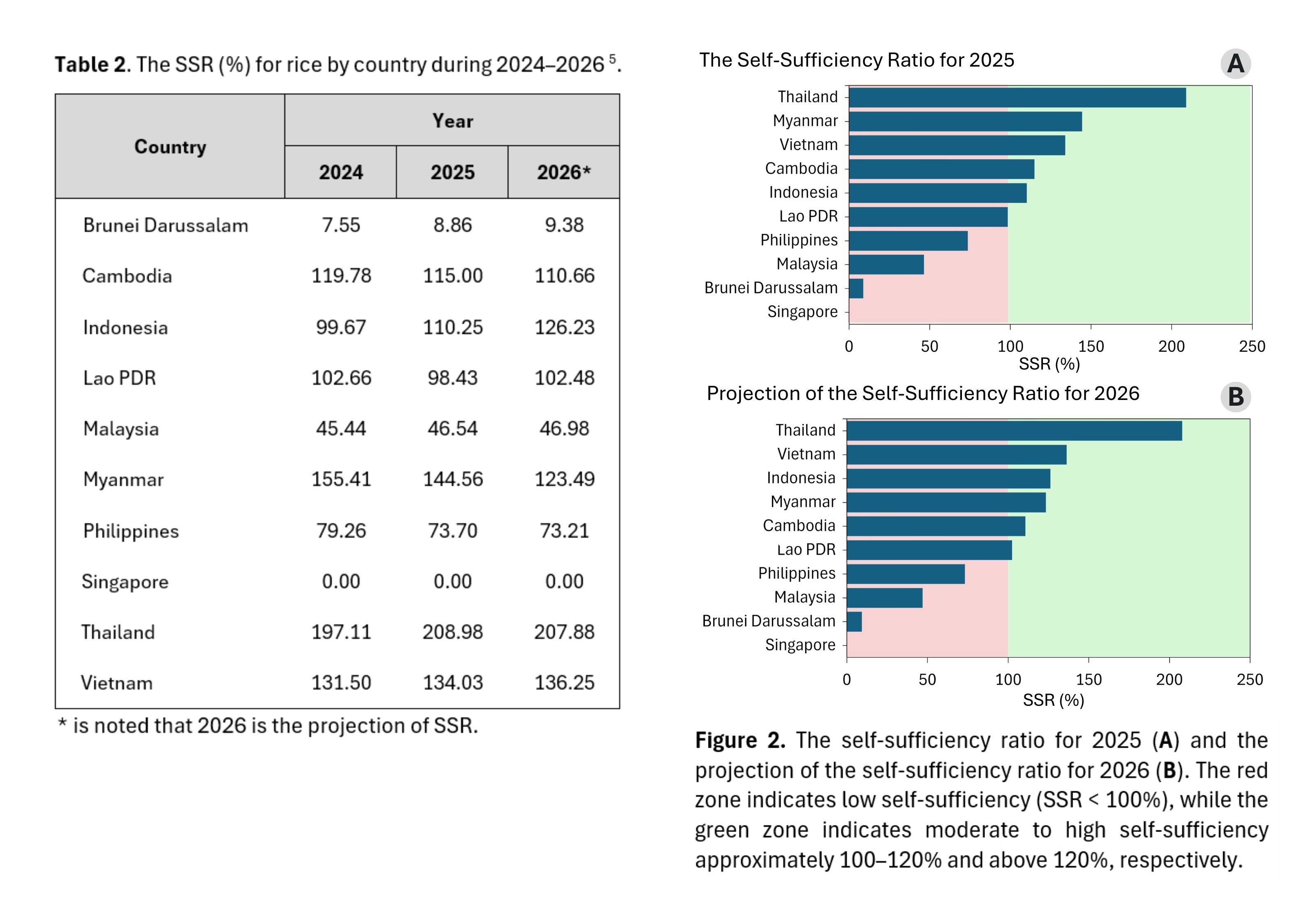
Four countries, including Thailand, Vietnam, Myanmar, and Cambodia, produce significantly more rice than they consume. Thailand remains the most self-sufficient country, with SSR increasing from 197.11% in 2024 to 208.98% in 2025, before slightly declining to 207.88% in 2026. Vietnam shows a strong and steadily increasing surplus, rising from 131.50% in 2024 to 134.03% in 2025 and further to 136.25% in 2026. Myanmar, while still highly self-sufficient, shows a declining trend, decreasing from 155.41% in 2024 to 144.56% in 2025 and further to 123.49% in 2026. Cambodia remains above the self-sufficiency threshold but shows a declining trend, from 119.78% to 110.66% (Table 2), moving closer to a balanced position (Figure 2).
Indonesia and Lao People’s Democratic Republic (Lao PDR) are relatively balanced between production and consumption. Indonesia shows significant improvement, increasing from 99.67% in 2024 (near deficit) to 110.25% in 2025 and 126.23% in 2026, shifting into a surplus position. Lao PDR fluctuates around the self-sufficiency level, from 102.66% in 2024 to 98.43% in 2025 and 102.48% in 2026 (Table 2), indicating a near balanced situation (Figure 2). Several countries remain below the self-sufficiency level and rely on imports to meet domestic demand, including the Philippines, Malaysia, Brunei Darussalam, and Singapore. The Philippines shows a declining trend and remains consistently below 100%, from 79.26% in 2024 to 73.70% in 2025 and 73.21% in 2026, indicating increasing dependence on imports. Malaysia shows slight improvement but remains highly import-dependent, increasing from 45.44% in 2025 to 46.98% in 2026. Brunei Darussalam remains very low but shows gradual improvement, from 7.55% in 2025 to 9.38% in 2026, reflecting minimal domestic production. Singapore remains fully dependent on imports, with an SSR of 0% (Table 2 and Figure 2).
In conclusion, the ASEAN regional SSR shows a steady increase from 118.85% in 2024 to 121.16% in 2025 and 123.55% in 2026. This indicates that the region is becoming increasingly self-sufficient, driven primarily by surplus countries such as Thailand and Vietnam, as well as improvements in production in Indonesia. Moreover, it also indicates that rice production exceeds domestic consumption in both 2025 and 2026, with a slightly strengthened surplus position in 2026. In other words, the region becomes marginally more self-sufficient, with a greater buffer available for exports or stock accumulation. However, it is necessary to closely monitor the recent rapid increases in oil and fertilizer prices, driven by the conflict between the United States and Iran. This situation may affect and lead to a decline in rice production and could impact food security in the ASEAN region.
For more details click download PDF file: ASEAN Food Security Information on the Self-Sufficiency Ratio (SSR) for Rice
References

On 19 August 2026, the AFSIS Secretariat participated in the Special Senior Officials Meeting of the 25th Meeting of the ASEAN Ministers on Agriculture and Forestry Plus Three (Special SOM-25th AMAF Plus Three), hosted by the Philippines via video conference. The Meeting was attended by Senior Officials from ASEAN Member States, the Plus Three countries, and the ASEAN Secretariat. The AFSIS Secretariat was represented by Dr. Sumanya Ngandee, AFSIS Manager.
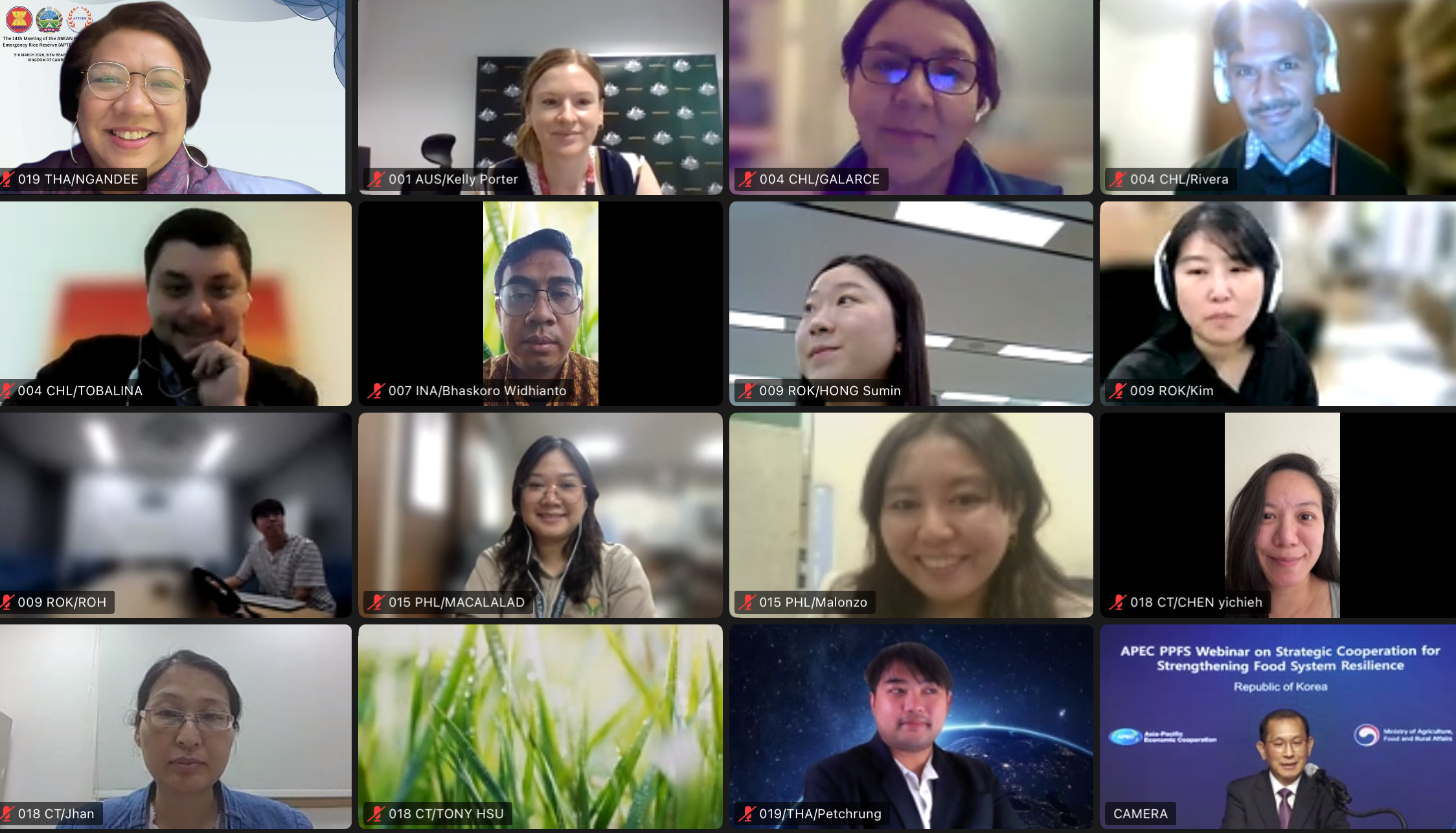
On 29 July 2026, the APEC Policy Partnership on Food Security (PPFS) successfully convened the APEC PPFS Webinar on Strategic Cooperation for Strengthening Food System Resilience via a virtual platform. The webinar was organized by the Ministry of Agriculture, Food and Rural Affairs (MAFRA) of the Republic of Korea as a self-funded PPFS project to promote strategic cooperation and knowledge exchange on strengthening food system resilience across APEC member economies.

The AFSIS Secretariat participated in the 10th International Conference on Agricultural Statistics (ICAS X), held from 8 to 10 July 2026 at the ICE Krakow Congress Centre in Krakow, Poland. Jointly organized by Statistics Poland, Eurostat, the United States Department of Agriculture (USDA), the World Bank Group, and the Food and Agriculture Organization of the United Nations (FAO).
.JPG)
On 24–25 June 2026, AFSIS Secretariat participated in the 46th Meeting of the ASEAN Food Security Reserve Board (AFSRB) via a virtual conference. The Meeting was jointly organized by the AFSRB Secretariat and the Department of Agriculture (DOA), Ministry of Agriculture, Livestock and Irrigation (MOALI) of the Republic of the Union of Myanmar, and was hosted in Nay Pyi Taw, Myanmar.

