/LINE_ALBUM_KRC_Cambodia_251204_13.jpg)
On 27 November 2025, Mr. Charapon Chantorn, Deputy AFSIS Manager, participated in the Completion and Handover Ceremony of the project “Establishing the Real-Time ASEAN Food Security Information System (AFSIS) and Development of Human Resources, Phase 3 – Pilot Project on Strategic Crop Forecasting System for Food Security in Cambodia.” The ceremony was held in Phnom Penh, Cambodia, and jointly hosted by the Ministry of Agriculture, Food and Rural Affairs (MAFRA) of the Republic of Korea, the Ministry of Agriculture, Forestry and Fisheries (MAFF) of Cambodia, and the Korea Rural Community Corporation (KRC).
The ceremony was presided over by H.E. Dr. Sar Chetra, Secretary General of the Ministry of Agriculture, Forestry and Fisheries (MAFF), Cambodia, and attended by senior representatives from MAFRA, KRC, and other relevant organizations.
The project aims to strengthen the ASEAN Food Security Information System (AFSIS) and to develop a strategic crop forecasting system to enhance food security in Cambodia and the region. The integration of the National Agri-Food Information System (NAIS) technology represents a significant advancement in agricultural planning, enabling more accurate and timely crop forecasting.
During the ceremony, Mr. Charapon delivered remarks on behalf of the AFSIS Secretariat, expressing appreciation to all Cambodian and Korean partners for their strong collaboration and the successful implementation of the project. He emphasized the importance of strategic crop forecasting, particularly advances in rice yield prediction, which play a vital role in Cambodia’s agricultural sector and regional food security.
The successful implementation of this pilot project is expected to enhance agricultural planning, improve production efficiency, and strengthen national food security in Cambodia. In the long term, the forecasting system will also serve as a foundation for expansion to other key crops, contributing to sustainable agricultural development in the country.
/LINE_ALBUM_KRC_Cambodia_251204_8.jpg)
/LINE_ALBUM_KRC_Cambodia_251204_9.jpg)
/LINE_ALBUM_KRC_Cambodia_251204_15.jpg)
/LINE_ALBUM_KRC_Cambodia_251204_5.jpg)
/LINE_ALBUM_KRC_Cambodia_251204_6.jpg)
/LINE_ALBUM_KRC_Cambodia_251204_2.jpg)
/LINE_ALBUM_KRC_Cambodia_251204_3.jpg)
/LINE_ALBUM_KRC_Cambodia_251204_4.jpg)
/LINE_ALBUM_KRC_Cambodia_251204_10.jpg)
/LINE_ALBUM_KRC_Cambodia_251204_12.jpg)
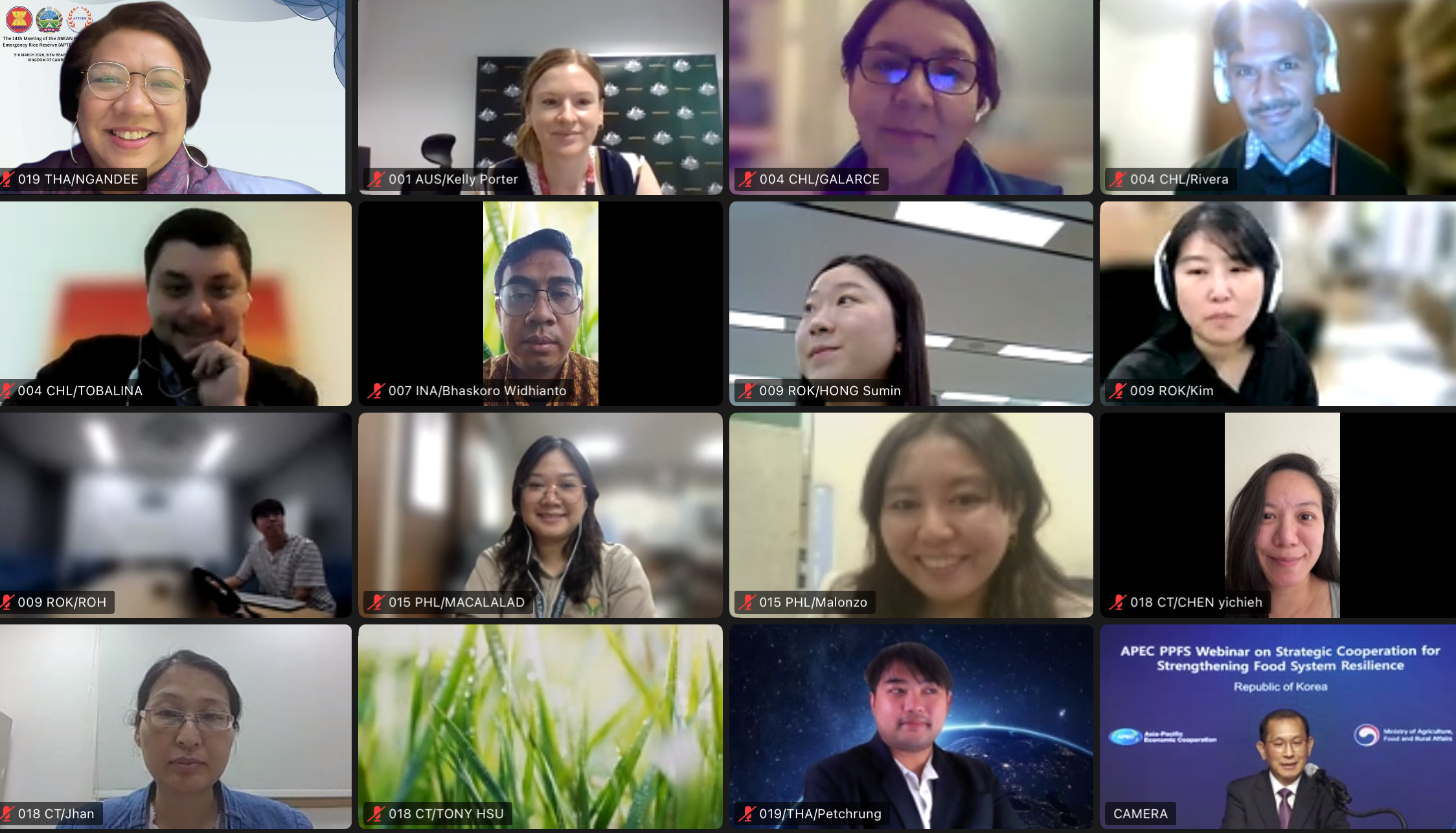
On 29 July 2026, the APEC Policy Partnership on Food Security (PPFS) successfully convened the APEC PPFS Webinar on Strategic Cooperation for Strengthening Food System Resilience via a virtual platform. The webinar was organized by the Ministry of Agriculture, Food and Rural Affairs (MAFRA) of the Republic of Korea as a self-funded PPFS project to promote strategic cooperation and knowledge exchange on strengthening food system resilience across APEC member economies.

The AFSIS Secretariat participated in the 10th International Conference on Agricultural Statistics (ICAS X), held from 8 to 10 July 2026 at the ICE Krakow Congress Centre in Krakow, Poland. Jointly organized by Statistics Poland, Eurostat, the United States Department of Agriculture (USDA), the World Bank Group, and the Food and Agriculture Organization of the United Nations (FAO).
.JPG)
On 24–25 June 2026, AFSIS Secretariat participated in the 46th Meeting of the ASEAN Food Security Reserve Board (AFSRB) via a virtual conference. The Meeting was jointly organized by the AFSRB Secretariat and the Department of Agriculture (DOA), Ministry of Agriculture, Livestock and Irrigation (MOALI) of the Republic of the Union of Myanmar, and was hosted in Nay Pyi Taw, Myanmar.

On 17–18 June 2026, the 24th AFSIS Focal Point Meeting was successfully convened via video conference, hosted by the Philippine Statistics Authority (PSA) in collaboration with the ASEAN Food Security Information System (AFSIS) Secretariat.

