.jpg)
The ASEAN Food Security Information System (AFSIS) Secretariat, in collaboration with the Ministry of Agriculture, Forestry and Fisheries (MAFF) Japan, Japan Aerospace Exploration Agency (JAXA), Remote Sensing Technology Center of Japan (RESTEC), and Geo-Informatics and Space Technology Development Agency (GISTDA), conducted the 2nd Hands-on Training Courses for Agricultural Statisticians, the Final Workshop, and the 2nd Seminar for Executive Officials under the JAIF Project entitled “Improvement of Rice Paddy Area Statistics and Damage Assessment using Earth Observation Satellites for ASEAN” in Sriracha, Chonburi Province, and Bangkok, Thailand.
From 25 to 27 May 2026, the 2nd Hands-on Training Courses were held at the ASEAN Research and Training Center for Space Technology and Applications (ARTSA) GISTDA in Sriracha, where participants from ASEAN Member States received practical training on the operation of the INAHOR (INternational Asian Harvest mOnitoring system for Rice) for rice planted area estimation and flood damage assessment using Earth observation technology. The training also included hands-on exercises on rice map creation and satellite image analysis using tools such as QGIS, Google Earth Pro, and Google Earth Engine.
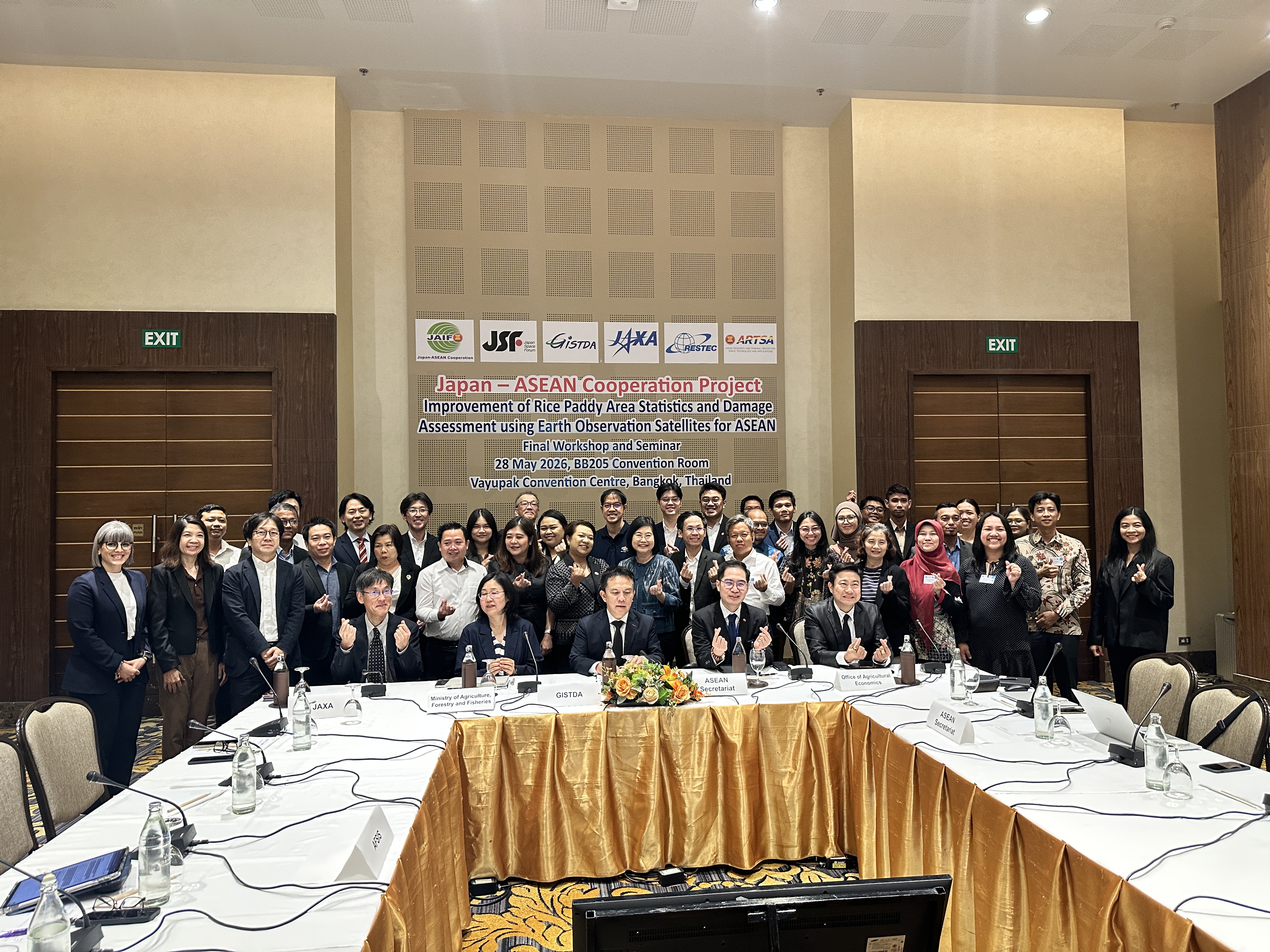
Following the training activities in Sriracha, the Final Workshop and Seminar were held at Vayupak Convention Centre, Centara Life Government Complex Hotel & Convention Centre on 28 May 2026 in Bangkok. The seminar served as a platform to share the outcomes of the project, review the results of the training activities, and discuss future directions for the utilization of Earth observation technologies and INAHOR applications in supporting agricultural statistics and food security in the ASEAN region.
The seminar featured opening remarks by Dr. Pakorn Apaphant, Executive Director of GISTDA; Dr. Soon Hong Kwan, a senior officer of the Science and Technology Division of the ASEAN Secretariat; Mr. Chanawat Sittitool, Deputy Secretary General of the Office of Agricultural Economics (OAE), Ministry of Agriculture and Cooperatives of Thailand; Ms. Emiko Morimoto, Deputy Director of the Statistics Department, MAFF Japan; and Dr. Shinichi Sobue, Senior Adviser of JAXA.
The program included presentations on project achievements and outcomes, summaries of the hands-on training activities carried out during 25-27 May 2026, and country presentations on INAHOR estimation results by representatives from Thailand, Lao PDR, and Malaysia.
In addition, the seminar highlighted the future direction of the AFSIS Geospatial Informatization Support (AFSIS-GIS) project implemented by the AFSIS Secretariat, which aims to utilize the outcomes of the JAIF Project to support the dissemination of country-level and provincial-level rice maps, including INAHOR-based GIS products, through the AFSIS website.
The training courses, workshops, and seminars highlighted the importance of regional cooperation and technological innovation in strengthening agricultural information systems, particularly amid increasing climate variability and emerging food security challenges in the ASEAN region. The JAIF Project also supports the objectives of the ASEAN Integrated Food Security (AIFS) Framework by enhancing the capacity of ASEAN Member States to generate timely, accurate, and reliable agricultural statistics through the application of Earth observation technologies.
The 2nd Hands-on Training Courses, Final Workshop, and Seminar marked another important milestone of the JAIF Project and reaffirmed the continued cooperation among ASEAN Member States, the AFSIS Secretariat, and partner organizations in promoting evidence-based agricultural monitoring and strengthening regional food security resilience.
.JPG)
.JPG)
.JPG)
.jpg)
.jpg)
.jpg)
.jpg)
.jpg)
.jpg)
.JPG)
.JPG)
.JPG)
.jpg)
.JPG)
.JPG)
.JPG)
.JPG)
.JPG)
.JPG)
.JPG)
.JPG)

On 19 August 2026, the AFSIS Secretariat participated in the Special Senior Officials Meeting of the 25th Meeting of the ASEAN Ministers on Agriculture and Forestry Plus Three (Special SOM-25th AMAF Plus Three), hosted by the Philippines via video conference. The Meeting was attended by Senior Officials from ASEAN Member States, the Plus Three countries, and the ASEAN Secretariat. The AFSIS Secretariat was represented by Dr. Sumanya Ngandee, AFSIS Manager.
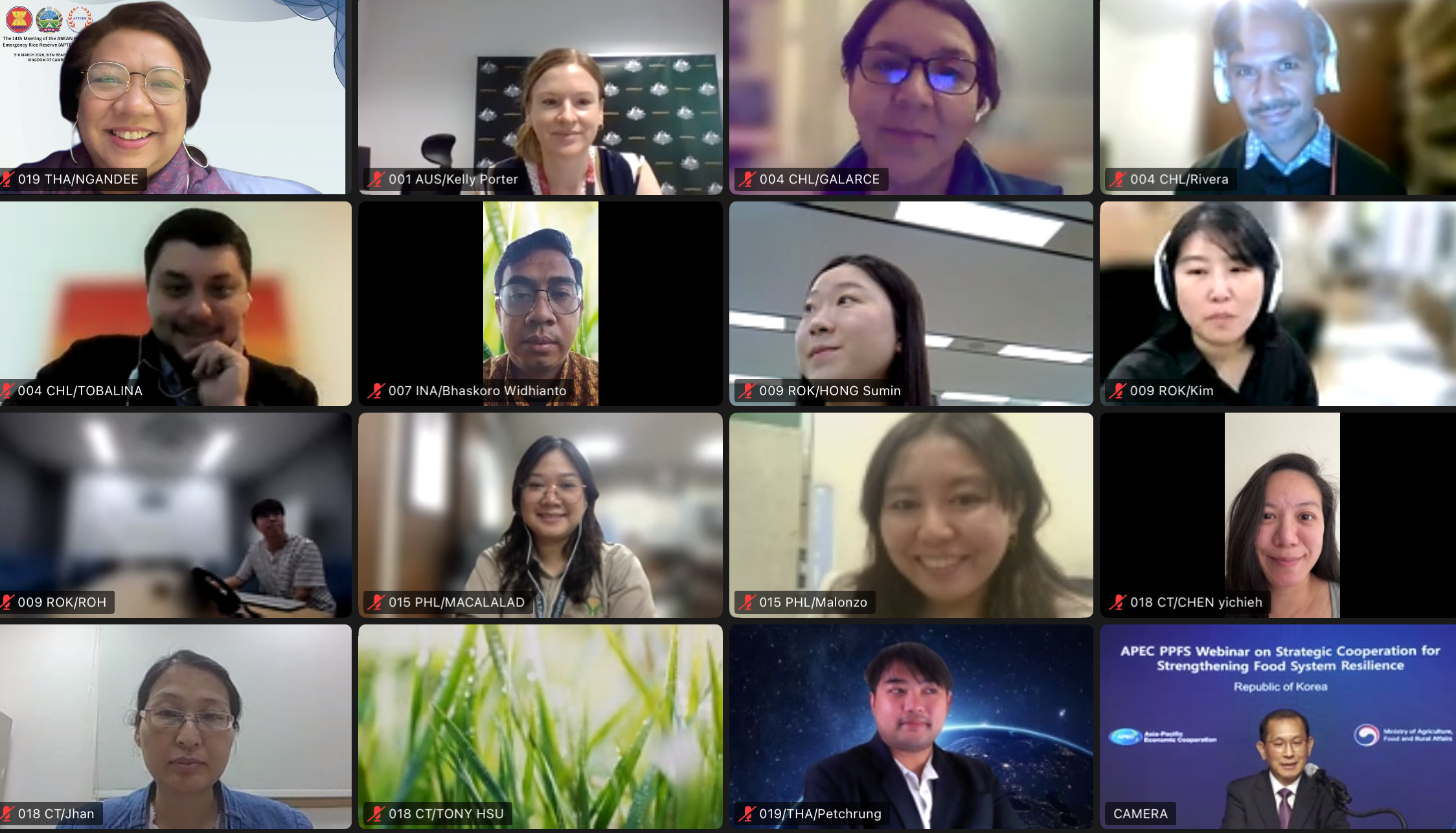
On 29 July 2026, the APEC Policy Partnership on Food Security (PPFS) successfully convened the APEC PPFS Webinar on Strategic Cooperation for Strengthening Food System Resilience via a virtual platform. The webinar was organized by the Ministry of Agriculture, Food and Rural Affairs (MAFRA) of the Republic of Korea as a self-funded PPFS project to promote strategic cooperation and knowledge exchange on strengthening food system resilience across APEC member economies.

The AFSIS Secretariat participated in the 10th International Conference on Agricultural Statistics (ICAS X), held from 8 to 10 July 2026 at the ICE Krakow Congress Centre in Krakow, Poland. Jointly organized by Statistics Poland, Eurostat, the United States Department of Agriculture (USDA), the World Bank Group, and the Food and Agriculture Organization of the United Nations (FAO).
.JPG)
On 24–25 June 2026, AFSIS Secretariat participated in the 46th Meeting of the ASEAN Food Security Reserve Board (AFSRB) via a virtual conference. The Meeting was jointly organized by the AFSRB Secretariat and the Department of Agriculture (DOA), Ministry of Agriculture, Livestock and Irrigation (MOALI) of the Republic of the Union of Myanmar, and was hosted in Nay Pyi Taw, Myanmar.

